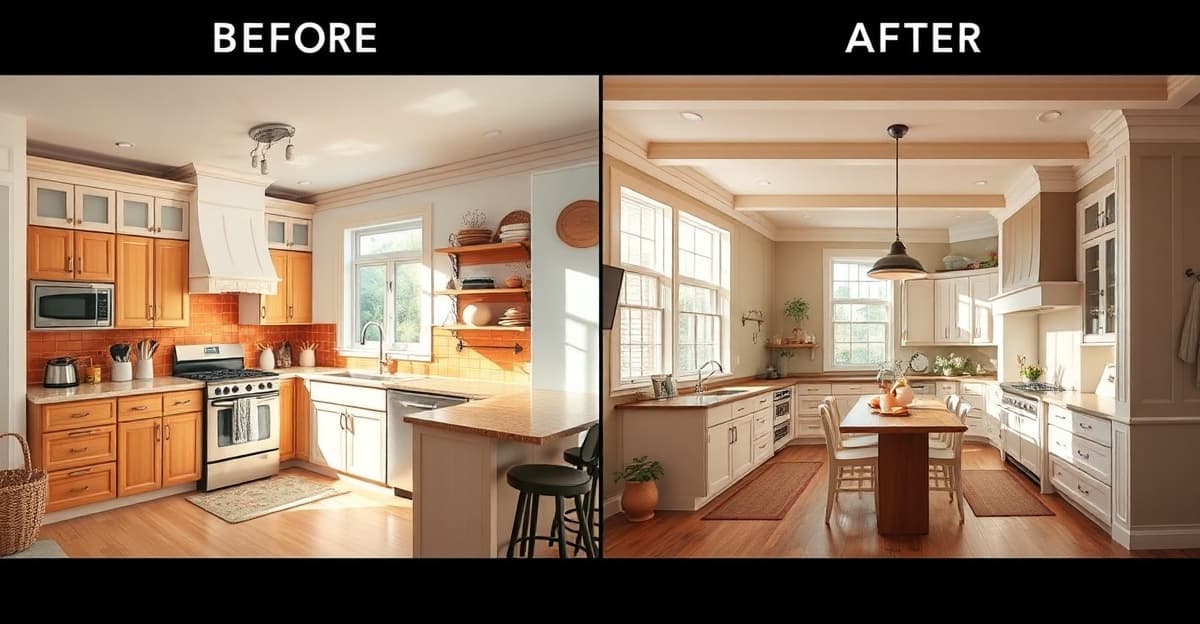
Kitchen cabinets consume 30–40% of a typical kitchen renovation budget and define the room’s visual character more than any other element. Choose the wrong style and you’re looking at $8,000–$25,000 in regret every time you walk into your kitchen.
Three cabinet door styles dominate the market in 2026: shaker, flat-panel (slab), and glass-front. Each has distinct strengths, cost profiles, and kitchen styles where it works best. This guide gives you the real comparison — not the vague “it depends on your taste” advice you find elsewhere.
Want to skip to seeing these styles in your kitchen? Our cabinet visualizer lets you upload a kitchen photo and compare all three styles on your actual cabinets for free.
Shaker Cabinets: The Reliable Classic
Shaker cabinets feature a five-piece door with a flat center panel and clean, recessed lines. The style originated with the Shaker religious community in the 18th century, whose design philosophy emphasized simplicity, utility, and honest craftsmanship. That same philosophy is why shaker cabinets have remained popular for over 200 years — they are genuinely timeless.
Construction: A shaker door uses a frame-and-panel construction — four pieces form the outer frame (two stiles and two rails) with a flat panel set into the center. This construction is inherently sturdy. The clean lines come from the frame edges being flat and square, without any decorative routing or ornamentation.
Cost: Shaker cabinets sit in the mid-range. Stock shaker cabinets start at $80–$200 per linear foot. Semi-custom options run $150–$400 per linear foot. Full custom shaker cabinets can reach $500–$1,200 per linear foot, depending on wood species and finish. For a typical 20-linear-foot kitchen, budget $3,000–$12,000 for cabinets alone (before installation).
Best kitchen types:
- Transitional kitchens — shaker bridges traditional and modern effortlessly
- Farmhouse and cottage kitchens — especially in white or cream paint
- Traditional kitchens — shaker adds structure without the fussiness of raised-panel
- Smaller kitchens — the subtle frame detail adds visual interest without overwhelming compact spaces
What to watch out for: The grooves between the frame and panel can collect grease and dust, requiring slightly more cleaning effort than flat surfaces. This is a minor issue but worth noting if you cook frequently and hate cleaning cabinet faces.
Flat-Panel (Slab) Cabinets: The Modern Minimalist
Flat-panel cabinets — also called slab doors — are exactly what they sound like: a single, flat piece of material with no frame, no panel, and no detailing. The door is the surface, and the surface is the door. The result is a completely smooth, uninterrupted plane.
Construction: Slab doors can be made from solid wood, MDF (medium-density fiberboard) with veneer or laminate, plywood, or even materials like acrylic and aluminum for ultra-modern applications. Solid wood slab doors can be prone to warping over time, so many manufacturers use engineered substrates with a decorative surface layer for dimensional stability.
Cost: Flat-panel cabinets have the widest price range of the three styles. Budget laminate slab cabinets start as low as $60–$150 per linear foot. Mid-range options with wood veneer or high-pressure laminate run $150–$350 per linear foot. High-end options in natural wood or specialty finishes can reach $400–$1,000+ per linear foot. The simplicity of the door does not always mean a lower price — achieving a truly flawless flat surface in premium materials is technically demanding.
Best kitchen types:
- Modern and contemporary kitchens — flat panels are the defining element of modern kitchen design
- Minimalist spaces — the absence of detail is the design statement
- Small kitchens — the smooth surface and optional handleless hardware create an uncluttered, space-expanding effect
- Open-plan kitchens — flat panels let the kitchen integrate visually with living spaces without screaming “kitchen”
What to watch out for: Flat surfaces show fingerprints, smudges, and surface imperfections more readily than textured doors. Matte finishes hide fingerprints better than gloss, but high-gloss flat-panel kitchens (while stunning when clean) require frequent wiping. Also, some people find fully flat cabinets “boring” or “office-like” without complementary design elements like open shelving, mixed materials, or distinctive hardware.
Glass-Front Cabinets: The Display Statement
Glass-front cabinets use a frame-and-panel construction similar to shaker cabinets, but replace the solid center panel with glass. They function as display cases, allowing the contents to be seen while still being enclosed and protected from dust and grease.
Construction: The frame is typically wood or MDF (similar to shaker frames), with the center panel replaced by glass. Glass options include clear, frosted, seeded, reeded, and textured varieties. Frosted and reeded glass offer a softer look and partially obscure the contents — useful if your dishes are more functional than decorative. Some manufacturers offer leaded glass or mullion (divided-light) patterns for a more traditional aesthetic.
Cost: Glass-front cabinets are the most expensive of the three styles. Stock options with clear glass start at $150–$300 per linear foot. Semi-custom options with specialty glass run $300–$600 per linear foot. Custom glass-front cabinets with leaded or art glass can reach $600–$1,500+ per linear foot. Specialty glass alone can add $50–$200 per door over a standard panel door.
Best kitchen types:
- Traditional and classic kitchens — glass-front uppers are a hallmark of traditional kitchen design
- Transitional kitchens — mixing glass-front uppers with solid-door lowers creates visual contrast
- Kitchens with display-worthy items — matching dinnerware sets, glassware collections, or decorative objects
- Large kitchens — glass-front cabinets break up long runs of solid doors and add visual lightness
What to watch out for: Glass-front cabinets demand organized interiors. Everything inside is on display, so mismatched dishes, food packaging, and general clutter are visible. Interior cabinet lighting is almost mandatory for glass-fronts to look their best — add $50–$150 per cabinet for LED puck lights or strip lighting. The glass itself requires cleaning inside and out. And glass-front doors are more fragile than solid doors, which matters in households with young children.
Cost Comparison Table
| Factor | Shaker | Flat-Panel | Glass-Front |
|---|---|---|---|
| Stock (per linear ft) | $80–$200 | $60–$150 | $150–$300 |
| Semi-custom (per linear ft) | $150–$400 | $150–$350 | $300–$600 |
| Custom (per linear ft) | $500–$1,200 | $400–$1,000 | $600–$1,500 |
| Avg kitchen (20 linear ft, mid-range) | $3,000–$8,000 | $3,000–$7,000 | $6,000–$12,000 |
| Installation (additional) | $2,000–$5,000 | $2,000–$5,000 | $2,500–$6,000 |
Key insight: Flat-panel cabinets are often the cheapest at the budget end (simple laminate slabs) but can match or exceed shaker pricing at the premium end. Glass-front cabinets are always the most expensive due to the glass itself and the additional construction complexity.
Most homeowners find the best value in using a combination: shaker or flat-panel for the majority of cabinets, with a few strategic glass-front uppers as accent pieces. This gives you the display effect without the full cost of an all-glass-front kitchen.
For a personalized cost estimate based on your kitchen size and cabinet budget, try our renovation cost estimator.
2026 Trend Data and Market Direction
Cabinet trends matter because they affect both how your kitchen feels today and how it ages over the next 10–15 years. Here is where each style stands in 2026:
Shaker cabinets remain the single most popular cabinet door style in the US market. According to the National Kitchen and Bath Association (NKBA), shaker-style doors have been the top choice in new kitchens for over a decade. The style has proven effectively trend-proof — it was popular in 2010, it is popular in 2026, and it will almost certainly be popular in 2036. If you prioritize longevity over making a design statement, shaker is the safest bet.
Flat-panel cabinets are the fastest-growing segment. As contemporary and minimalist design has moved from niche to mainstream, flat-panel adoption has surged. The style is dominant in European kitchen design (which historically leads US trends by 3–5 years) and is increasingly specified by designers for US kitchens. Handleless flat-panel designs (using push-to-open mechanisms or integrated pulls) are the specific sub-trend to watch.
Glass-front cabinets have shifted from a default in traditional kitchens to a strategic accent element. The trend in 2026 is using reeded or fluted glass (vertically textured glass that partially obscures contents) rather than clear glass. This provides the visual interest and depth of glass doors while being more forgiving of what’s inside. Full kitchens with all glass-front uppers are less common than they were a decade ago.
The emerging trend: Mixed cabinet door styles within a single kitchen. Flat-panel base cabinets with shaker or glass-front uppers. Or shaker perimeter cabinets with a flat-panel island. This mixing approach gives kitchens more visual depth than a single door style throughout.
Which Style Fits Your Kitchen?
Cabinet style decisions are best made in context — meaning in your actual kitchen, not a showroom. Here is a practical decision framework:
Choose shaker if:
- You want a safe, timeless choice that will look good for 15+ years
- Your kitchen has a mix of traditional and modern elements
- You’re renovating for resale — shaker appeals to the widest range of buyers
- You want visual interest on the cabinet doors without being ostentatious
- Your budget is mid-range and you want reliable quality
Choose flat-panel if:
- You want a clean, modern, or minimalist kitchen
- Your kitchen is open-plan and needs to integrate with living spaces
- You prefer a handleless look with push-to-open or integrated pulls
- You’re willing to wipe down surfaces regularly (especially with gloss finishes)
- You want your countertops, backsplash, or hardware to be the focal point — not the cabinet doors
Choose glass-front if:
- You have dishware, glassware, or decorative items you want to display
- Your kitchen has long runs of upper cabinets that would feel heavy in solid doors
- You’re willing to keep cabinet interiors organized and presentable
- You want to add visual depth and lightness to a traditional or transitional kitchen
- Your budget accommodates the premium cost
The best way to decide is to see the styles in your actual kitchen — not someone else’s. Our cabinet visualizer lets you upload a photo of your kitchen and compare shaker, flat-panel, and glass-front doors on your own cabinets. It takes seconds and is completely free to try.
Combining Cabinet Styles
You do not have to commit to a single cabinet door style throughout your kitchen. In fact, mixing styles is one of the strongest design trends in 2026 and can give your kitchen a custom, curated look.
Popular combinations:
- Shaker base + glass-front uppers: The classic combination. Shaker provides the workhorse function for daily-use cabinets, while glass-front uppers add display elegance. Works beautifully in transitional and traditional kitchens.
- Flat-panel base + shaker uppers: A modern-leaning mix that prevents the kitchen from feeling too cold or minimal. The shaker uppers add just enough detail to warm things up.
- Flat-panel perimeter + flat-panel island in a contrasting color: Technically the same style but with different finishes (e.g., white perimeter cabinets with a navy or charcoal island). This two-tone approach has been the dominant kitchen trend for several years and shows no signs of fading.
- Any style base + open shelving uppers: Replacing some or all upper cabinets with open shelving creates an airy, accessible kitchen and eliminates the upper cabinet style decision entirely.
If you are considering a mixed approach, visualizing it first is especially important. What sounds good in theory can look disjointed in practice — or, just as often, a combination you would not have considered turns out to be the best option. Compare all styles on your kitchen photo to test different combinations before committing.
The Bottom Line
All three cabinet styles are strong choices when matched to the right kitchen. The “best” style is the one that fits your kitchen’s architecture, your daily habits, and your budget.
If forced to give one recommendation: shaker is the lowest-risk choice for most kitchens. It is timeless, works across styles, appeals to the broadest audience for resale, and sits at a comfortable mid-range price point. It is the “you can’t go wrong” option.
If you have a clear design vision and are renovating for yourself (not for resale), flat-panel and glass-front can create more distinctive, personal kitchens. Flat-panel is the bold modern choice. Glass-front is the elegant traditional choice. And combining styles gives you the best of multiple worlds.
Whatever you’re leaning toward, see it on your own kitchen first. Upload a photo to our cabinet visualizer, compare styles side by side, and make your decision with confidence instead of guesswork.