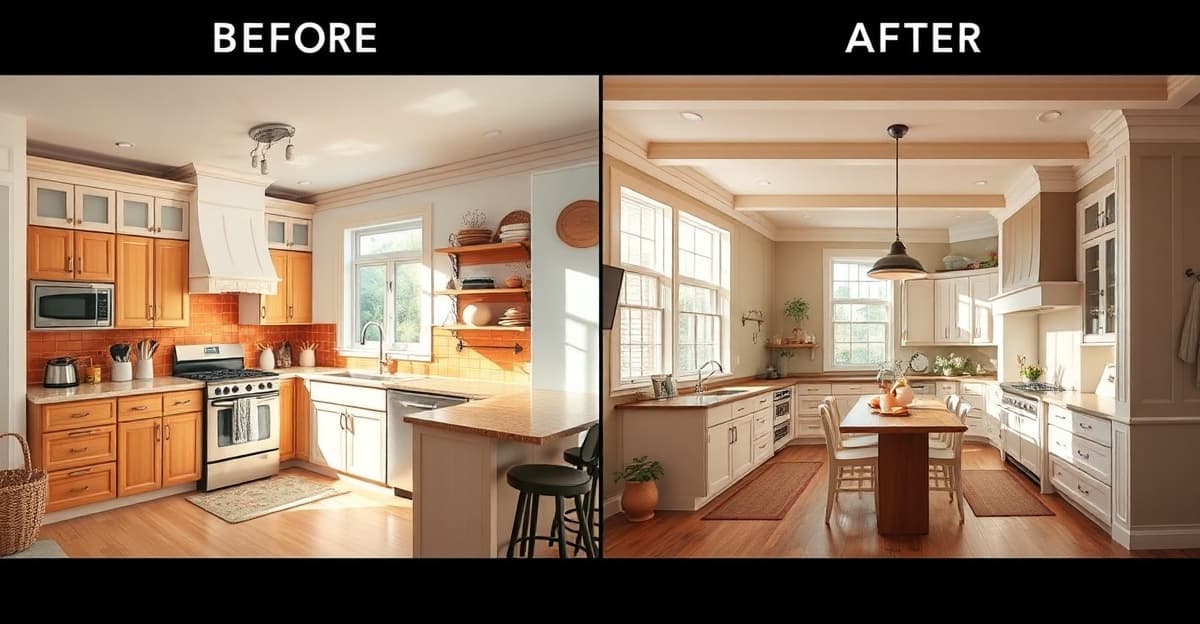
Choosing between quartz and granite is one of the biggest decisions in any kitchen renovation. Together, these two materials account for over 70% of countertop installations in the US, and for good reason — both are durable, attractive, and hold their value well.
But they’re not interchangeable. Quartz and granite differ in how they’re made, how they perform under daily use, how much they cost, and how they look in different kitchen styles. This guide breaks down the real differences so you can make an informed choice — not one based on a showroom sales pitch.
If you want to skip straight to seeing both materials in your actual kitchen, try our free countertop visualizer. Upload a photo and compare quartz vs granite on your own counters in seconds.
What Are Quartz and Granite Countertops?
Before comparing performance, it helps to understand what you’re actually buying.
Granite is a natural stone. It’s quarried from the earth in large slabs, cut to size, and polished. Every slab is unique because the mineral composition varies naturally. What you see in the showroom is literally what you get — no two granite countertops are identical.
Quartz (also called engineered stone) is manufactured. It’s made from roughly 90–94% ground natural quartz crystals mixed with 6–10% polymer resins and pigments. The manufacturing process means the patterns are consistent and reproducible — you can order more of the same slab months later and it will match.
This fundamental difference — natural vs engineered — drives most of the practical distinctions between the two materials.
Cost Comparison
Material and installation costs are often the deciding factor. Here’s what you can realistically expect to pay in 2026:
| Cost Factor | Quartz | Granite |
|---|---|---|
| Material per sq ft | $50–$150 | $40–$200 |
| Installation per sq ft | $10–$30 | $10–$30 |
| Total installed (avg kitchen, 30 sq ft) | $1,800–$5,400 | $1,500–$6,900 |
| Sealing (ongoing) | Not required | $100–$200/year |
The nuance: Granite has a wider price range because rarity drives cost. Common granites (like Ubatuba or Santa Cecilia) can be cheaper than mid-range quartz. But exotic granites (like Blue Bahia or Azul Macaubas) can cost $200+ per square foot — well above even premium quartz like Calacatta from Caesarstone or Cambria.
For a typical 30-square-foot kitchen countertop, the installed cost for both materials falls in a similar range of $2,000–$5,000. The real cost difference often comes down to the specific slab you choose, not the material category.
Want a quick estimate for your kitchen? Our renovation cost estimator can give you a regionalized cost breakdown based on your countertop size and material choice.
Durability and Hardness
Both materials are hard — but they handle abuse differently.
Granite scores a 6–7 on the Mohs hardness scale, making it highly scratch-resistant. It can handle a knife blade without visible damage in most cases (though you should still use a cutting board). However, granite is a natural stone with microscopic pores and occasional fissures. A heavy impact on an unsupported edge or near a fissure can cause chipping or cracking.
Quartz scores a 7 on the Mohs scale, making it slightly harder. The resin binder also gives it more flex than natural stone, making it more resistant to cracking from impact. Quartz is less likely to chip at edges and handles the everyday bumps and drops of a busy kitchen better than granite.
Winner: Quartz — marginally. Both are durable enough for decades of daily use, but quartz’s resin binder gives it an edge in impact resistance and chip resistance. In practice, either material will last 25+ years with reasonable care.
Maintenance and Sealing
This is where the two materials diverge significantly.
Granite requires sealing. Because it’s porous, unsealed granite can absorb liquids — wine, oil, coffee, tomato sauce — and stain permanently. Most granite countertops need to be sealed once a year, a process that takes about 30 minutes and costs $100–$200 if done professionally (or $15–$30 for a DIY kit). Some lighter-colored granites need sealing twice a year.
Quartz requires no sealing. The resin binder creates a non-porous surface that resists staining without any treatment. You clean it with soap and water. That’s it. No annual maintenance, no special products, no worrying about red wine spills.
For daily cleaning, both materials are straightforward. Granite needs a pH-neutral cleaner (harsh chemicals can strip the sealant). Quartz is less fussy — most household cleaners work fine, though abrasive pads should be avoided.
Winner: Quartz — clearly. The zero-maintenance aspect is one of the primary reasons quartz has overtaken granite in market share over the past decade.
Heat Resistance
This is granite’s strongest advantage.
Granite handles heat exceptionally well. It’s formed under extreme heat and pressure deep in the earth, so a hot pot or pan placed directly on the surface won’t cause any damage. You can pull a baking sheet out of a 450°F oven and set it directly on granite without a second thought.
Quartz is vulnerable to heat. The resin binders that give quartz its non-porous quality start to discolor and can crack at temperatures above 300°F (150°C). A hot pan placed directly on quartz can leave a permanent white mark or “thermal shock” ring. Trivets and hot pads are mandatory, not optional.
This is a meaningful difference for serious home cooks. If you regularly transfer hot cookware directly from the stove or oven to the counter, granite is the safer choice. If you already use trivets or hot pads as a habit, the difference is irrelevant.
Winner: Granite — decisively. This is the one performance category where granite is clearly superior, and it matters most in kitchens with heavy cooking activity.
Appearance and Style Options
Aesthetics are subjective, but the practical differences in appearance are worth understanding.
Granite offers natural, one-of-a-kind patterns. Every slab has unique veining, speckling, and color variation. This means you need to visit a stone yard and hand-select your exact slab — photos and samples only tell part of the story. The natural variation is either a feature (every kitchen is unique) or a drawback (you can’t perfectly match seams on large kitchens or replace a damaged section later).
Quartz offers controlled, consistent patterns. Manufacturers like Caesarstone, Cambria, Silestone, and MSI produce hundreds of designs, including convincing marble lookalikes (Calacatta, Carrara) that deliver the marble aesthetic without marble’s fragility. The consistency means seams are less visible, replacement sections can match perfectly, and you know exactly what you’re getting before installation.
In terms of style compatibility:
- Modern and contemporary kitchens tend to favor quartz for its clean, uniform appearance
- Traditional and rustic kitchens often suit granite’s natural character and organic patterns
- Transitional kitchens work well with either material
Not sure which would look better in your kitchen? Our countertop visualizer lets you upload a photo of your kitchen and see both quartz and granite options applied to your actual counters. It takes about 10 seconds and it’s free to try.
Resale Value and ROI
Both quartz and granite are considered premium countertop materials by home buyers and appraisers. Neither will hurt your resale value — both are significant upgrades over laminate, tile, or solid surface countertops.
Granite has traditionally been the gold standard in kitchen countertops and still carries prestige with many buyers, particularly in higher-end markets. Real estate agents consistently list granite countertops as a selling feature.
Quartz has overtaken granite in consumer preference and new installations. In 2025, quartz held approximately 35% of the US countertop market vs granite’s 18%. Younger home buyers (millennials and Gen Z) tend to prefer quartz for its low-maintenance qualities and modern aesthetic.
Both materials typically deliver a 60–80% return on investment at resale — meaning a $4,000 countertop installation adds roughly $2,400–$3,200 to your home’s value. The specific ROI depends more on your local market and the overall kitchen condition than on whether you chose quartz or granite.
For a detailed ROI estimate on your kitchen renovation, check our renovation ROI calculator.
Environmental Considerations
If sustainability factors into your decision, here is an honest assessment.
Granite is mined, which involves quarrying, transportation of heavy slabs (often from Brazil, India, or Italy), and significant energy use in cutting and polishing. The environmental footprint of the supply chain is substantial. On the positive side, granite is a fully natural material with no synthetic components, and old granite can be repurposed.
Quartz manufacturing uses ground quartz (which is abundant) but also petroleum-based resins. The manufacturing process is energy-intensive. However, because quartz is produced domestically in many countries, the transportation footprint can be smaller. Some manufacturers (like Caesarstone) have made strides in sustainability, including reducing water usage and emissions.
Neither material is clearly “green.” If environmental impact is a priority, consider locally sourced stone (which reduces transportation) or newer sustainable alternatives like recycled glass countertops or porcelain slabs.
The Verdict: Which Should You Choose?
Choose quartz if:
- Low maintenance is a priority — you want to clean with soap and water and never think about sealing
- You prefer a consistent, uniform appearance with minimal variation between slabs
- You want a marble look without marble’s maintenance headaches
- Your kitchen style is modern, contemporary, or minimalist
- You have young children and want maximum stain resistance
Choose granite if:
- You want a natural, one-of-a-kind stone with unique character
- Heat resistance matters — you regularly place hot cookware directly on the counter
- Your kitchen style is traditional, rustic, or Mediterranean
- You enjoy the process of hand-selecting a unique slab at a stone yard
- You prefer a fully natural material with no synthetic components
For most homeowners renovating a kitchen in 2026, quartz is the safer default choice. It matches most kitchen styles, requires zero maintenance, and has overtaken granite in consumer preference and market share. But granite remains an excellent material that makes particular sense for traditional kitchens, serious home cooks, and anyone who values the uniqueness of natural stone.
The best way to decide? See both options on your actual countertops. Upload a kitchen photo and compare quartz and granite side by side in seconds. It’s free and takes the guesswork out of the decision.